A phone assistant takes the call
An organisation whose phone rings more often than there are hands to answer it loses out twice: outside office hours and during busy periods nobody picks up, and whoever does answer puts something else down to do it. A phone AI assistant sits on that number, always answers, and chooses between three routes itself.
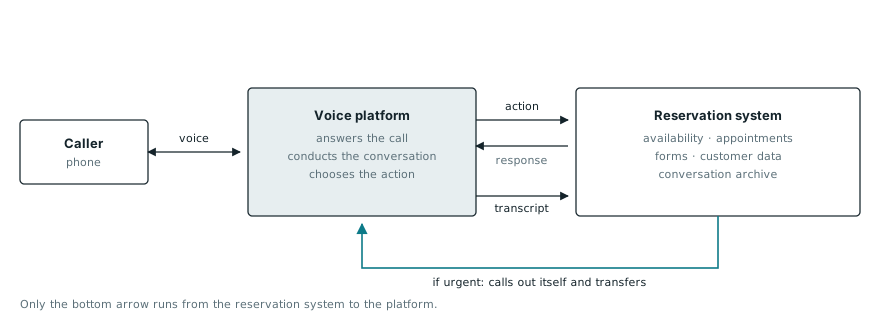
The assistant does not run inside the reservation system. The system provides the actions, stores the conversation, and in one scenario sets up a second phone call itself.
Route 1: scheduling an appointment
The caller wants an appointment. The assistant asks what it is about and when suits, looks up availability, offers at most three times, asks for the caller's name and confirms in one sentence what it is about to book. Only after an explicit "yes" is the booking created - what it is booked on is fixed in advance in the setup, the assistant never chooses that itself. The booking is linked to the customer and contact straight away, so it also shows up in the regular overviews.
Route 2: a message or callback request
If it can wait, it becomes a message. The assistant checks which fields the form requires, ticks off what it already knows - it has the phone number from the call itself - and asks only for the rest, one question at a time. It then summarises the message, reads it back, and waits for confirmation before sending it: a submitted form cannot be undone. It never promises a time by which someone will call back.
Route 3: getting a colleague on the line
If the caller says it is urgent, or explicitly asks for a person, i-Reserve itself sets up a second phone call to a colleague (the same mechanism as in Agent hands off to a colleague, applied here to telephony). The colleague first hears who is calling and about what, and decides with a single keypress whether to take the call. If they do not, the caller only hears that the colleague is not available - never that they declined, or why. Once the two calls are connected the assistant is done; if the colleague hangs up afterwards, the caller does not come back to it.
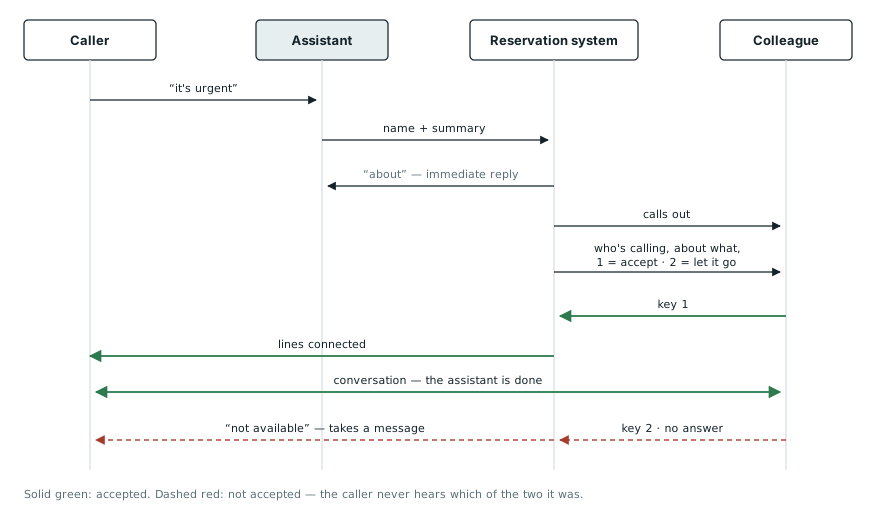
The colleague hears the summary on a line nobody else is on. Only after a keypress are the two calls connected; after that the assistant does nothing more.
What gets recorded
A phone call leaves four traces: the transcript and summary (in the same overview as chat and email), the tool calls that were executed (input, output, duration and any errors - visible on the conversation screen behind the right action_conversation_agentactivity), the actual booking or submitted form, and the telephony traffic itself (including how a transfer played out, useful for troubleshooting).
What needs to be set up
- A phone number that routes to the assistant, with matching instructions and voice.
- A limited list of allowed tools - only what the assistant actually uses.
- What gets booked on, and which form a message uses, fixed in advance.
- For transferring: an outbound number and at least one colleague with a name and phone number.
- The right action_conversation_agentactivity for who may view the executed actions.
Limits
- If nobody picks up, the summary ends up on the colleague's voicemail - and every attempt costs money, even without an answer.
- Anything outside these three routes goes out as a message.